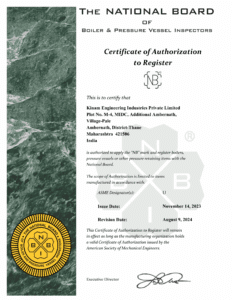


You know your heat exchanger must meet specific certification standards -
ASME USTAMP/IBR/NBBI/PED/ TRCU and/or the likes
And now you’re looking at two vendors – both certified.
Seems like a level playing field, right?
Not quite.
Because once certifications are on the table, the real question is:
Who will deliver the quality, documentation, and support your project demands - without delays, rework, or audit stress?
1. Certifications Are Just the Entry Ticket – Dig Deeper Into Process Maturity
Holding a certification only means a vendor can manufacture under that code.
What matters more is how often they do it, and how well their systems support it.
What to ask:
- How many certified jobs have they completed in the last 12 months?
- Do they have a full-time internal Quality Assurance team or rely on ad-hoc documentation when required?
- Can they show you sample dossiers – not just for the audit, but from real client deliveries?
2. How In-House Is Their Operation?
Certified fabrication demands control at every stage – from raw material selection to testing, NDT, documentation, and final inspection.
A vendor who outsources fabrication or testing loses control – and that’s where mistakes creep in.
What to check:
- Is design done in-house or outsourced to freelancers?
- Are welding, machining, and hydro testing done under their roof?
- Do they have in-house mechanical and thermal design engineers familiar with code calculations?
3. Check Their QAP/QCP Systems – Not Just for Certified Jobs
Many vendors create QAPs (Quality Assurance Plans) and QCPs (Quality Control Plans) only when required for certified jobs.
The best vendors?
They run those standards daily, certified job or not
Ask for:
- A sample QAP/QCP from a non-certified job – see how seriously they take quality every day
- Their internal audit frequency
- How they trace and store welding records, calibration reports, and test certificates
4. Don’t Just Look at the Price Tag – Look at the Risk Behind It
The lowest quote may look tempting – but here’s the hidden cost:
- A poorly documented dossier can delay IBR clearance by weeks
- A missing NDT report can lead to third-party rejection
- A weak design team can overspec or underspec – costing you performance and compliance
The best vendors price for peace of mind, not panic-mode firefighting
5. What’s Their Reputation with Third-Party Inspectors?
You’re not the only one who evaluates vendors – third-party inspectors from ASME, NBBI, and IBR do it all the time.
And they remember who makes their job easy, and who doesn’t.
Ask:
- Have they had any recent non-compliance reports?
- How many TPI-inspected jobs passed on the first attempt?
Here’s how to find out:
1. Certifications Are Just the Entry Ticket – Dig Deeper Into Process Maturity
Holding a certification only means a vendor can manufacture under that code.
What matters more is how often they do it, and how well their systems support it.
What to ask:
- How many certified jobs have they completed in the last 12 months?
- Do they have a full-time internal Quality Assurance team or rely on ad-hoc documentation when required?
- Can they show you sample dossiers – not just for the audit, but from real client deliveries?
2. How In-House Is Their Operation?
Certified fabrication demands control at every stage – from raw material selection to testing, NDT, documentation, and final inspection.
A vendor who outsources fabrication or testing loses control – and that’s where mistakes creep in.
What to check:
- Is design done in-house or outsourced to freelancers?
- Are welding, machining, and hydro testing done under their roof?
- Do they have in-house mechanical and thermal design engineers familiar with code calculations?
3. Check Their QAP/QCP Systems – Not Just for Certified Jobs
Many vendors create QAPs (Quality Assurance Plans) and QCPs (Quality Control Plans) only when required for certified jobs.
The best vendors?
They run those standards daily, certified job or not.
Ask for:
- A sample QAP/QCP from a non-certified job – see how seriously they take quality every day
- Their internal audit frequency
- How they trace and store welding records, calibration reports, and test certificates
4. Don’t Just Look at the Price Tag – Look at the Risk Behind It
The lowest quote may look tempting – but here’s the hidden cost:
- A poorly documented dossier can delay IBR clearance by weeks
- A missing NDT report can lead to third-party rejection
- A weak design team can overspec or underspec – costing you performance and compliance
The best vendors price for peace of mind, not panic-mode firefighting
5. What’s Their Reputation with Third-Party Inspectors?
You’re not the only one who evaluates vendors – third-party inspectors from ASME, NBBI, and IBR do it all the time.
And they remember who makes their job easy, and who doesn’t.
Ask:
- Have they had any recent non-compliance reports?
- How many TPI-inspected jobs passed on the first attempt?
Bottom Line: Certification Is Not the Final Check - It’s Just the Start
If your heat exchanger needs IBR, ASME U Stamp, or NBBI certification, you already know you can’t take shortcuts.
But remember: when both vendors look certified on paper, it’s the invisible systems that set them apart – not the logo at the bottom of the datasheet.
At Kinam, Certified Manufacturing Isn’t a Checklist – It’s Our DNA
We don’t just chase certifications. We built our entire process system to meet (and exceed) them.
In-house design, welding, NDE, and inspection
Every job – certified or not – follows full QAP & QCP protocol
Seamless interaction with IBR, ASME, and NBBI inspectors
Certified materials, calibrated testing, full traceability – always
And when the pressure’s on?
You won’t be wondering if we’ll deliver.
Need a quote or compare vendors?
Let us help you evaluate it – even if you don’t buy from us. Because doing it right the first time costs less than doing it twice.
You know your heat exchanger must meet specific certification standards – ASME USTAMP/IBR/NBBI/PED/ TRCU and/or the likes
And now you’re looking at two vendors – both certified.
Seems like a level playing field, right?
Not quite.
Because once certifications are on the table, the real question is:
Who will deliver the quality, documentation, and support your project demands – without delays, rework, or audit stress?
Here’s how to find out:
1. Certifications Are Just the Entry Ticket – Dig Deeper Into Process Maturity
Holding a certification only means a vendor can manufacture under that code.
What matters more is how often they do it, and how well their systems support it.
What to ask:
- How many certified jobs have they completed in the last 12 months?
- Do they have a full-time internal Quality Assurance team or rely on ad-hoc documentation when required?
- Can they show you sample dossiers – not just for the audit, but from real client deliveries?
2. How In-House Is Their Operation?
Certified fabrication demands control at every stage – from raw material selection to testing, NDT, documentation, and final inspection.
A vendor who outsources fabrication or testing loses control – and that’s where mistakes creep in.
What to check:
- Is design done in-house or outsourced to freelancers?
- Are welding, machining, and hydro testing done under their roof?
- Do they have in-house mechanical and thermal design engineers familiar with code calculations?
3. Check Their QAP/QCP Systems – Not Just for Certified Jobs
Many vendors create QAPs (Quality Assurance Plans) and QCPs (Quality Control Plans) only when required for certified jobs.
The best vendors?
They run those standards daily, certified job or not.
Ask for:
- A sample QAP/QCP from a non-certified job – see how seriously they take quality every day
- Their internal audit frequency
- How they trace and store welding records, calibration reports, and test certificates
4. Don’t Just Look at the Price Tag – Look at the Risk Behind It
The lowest quote may look tempting – but here’s the hidden cost:
- A poorly documented dossier can delay IBR clearance by weeks
- A missing NDT report can lead to third-party rejection
- A weak design team can overspec or underspec – costing you performance and compliance
The best vendors price for peace of mind, not panic-mode firefighting
5. What’s Their Reputation with Third-Party Inspectors?
You’re not the only one who evaluates vendors – third-party inspectors from ASME, NBBI, and IBR do it all the time.
And they remember who makes their job easy, and who doesn’t.
Ask:
- Have they had any recent non-compliance reports?
- How many TPI-inspected jobs passed on the first attempt?
Bottom Line: Certification Is Not the Final Check – It’s Just the Start
If your heat exchanger needs IBR, ASME U Stamp, or NBBI certification, you already know you can’t take shortcuts.
But remember: when both vendors look certified on paper, it’s the invisible systems that set them apart – not the logo at the bottom of the datasheet.
At Kinam, Certified Manufacturing Isn’t a Checklist – It’s Our DNA
We don’t just chase certifications. We built our entire process system to meet (and exceed) them.
In-house design, welding, NDE, and inspection
Every job – certified or not – follows full QAP & QCP protocol
Seamless interaction with IBR, ASME, and NBBI inspectors
Certified materials, calibrated testing, full traceability – always
And when the pressure’s on?
You won’t be wondering if we’ll deliver
Need a quote or compare vendors?
Let us help you evaluate it – even if you don’t buy from us. Because doing it right the first time costs less than doing it twice.